Beginners
Starting yoga after forty
Roughly half the people who come to their first class here are over forty, and almost all of them arrive apologising for it. A straight account of what is different, what isn't, and what to ignore.

The beginners' block runs three times a year and takes twelve people. The median age is 46. Almost every one of them says a version of the same thing in the first five minutes: I should have started this twenty years ago or I'm probably too stiff for this.
Both are wrong in ways worth being specific about.
What is genuinely different
Let's not pretend nothing changes. Three things do.
Tissue takes longer to adapt. Tendon and ligament remodelling is slower after about forty — the collagen turnover rate drops. Muscle responds nearly as fast as it ever did; connective tissue does not. In practice this means the same eight-week programme produces the same strength gains and slower flexibility gains, and it means that doing more, faster, is a worse strategy than it was at twenty-five.
Recovery windows lengthen. Not dramatically, but noticeably. Three hard sessions in a row is more likely to produce a flat fourth day.
You arrive with history. A shoulder from a fall in 2011. A back that goes once a year. This is the real difference, and it is not about age so much as accumulated specifics. It is also the most workable of the three, because a specific history can be worked around, whereas a vague fear cannot.
The limiting factor after forty is almost never capacity. It is that people who have been sedentary for a decade start at week six's intensity.
What is not different at all
Balance. Balance is a trainable skill at any age and it improves quickly — often within three weeks — because most of the early gain is neural rather than muscular. It is also the single most valuable thing in this practice for anyone over fifty, and the reason we keep standing balances in every Slow Flow.
Strength. Resistance adaptation continues into the eighties. The idea that strength gains stop in midlife is simply false.
Your ability to learn the shapes. No slower. Sometimes faster, because people who arrive at 46 tend to listen to instruction rather than watch the person in front.
What to ignore
A short list.
- Anything involving the word "advanced". Advanced in this practice means precise, not extreme. A well-organised triangle is a harder thing to produce than most arm balances.
- Photographs. Including ours. Every photograph of a yoga posture is a peak-end moment held for a camera, and it is not what the room looks like.
- The person on the next mat. They have been doing this for six years or they are a dancer or they have unusually mobile hips, and none of those facts is available to you from where you are standing.
- The idea that you need to be flexible first. This is the most common single reason people give for not starting, and it is exactly backwards. Flexibility is the output.
A sequence for the first month
If you want something to do at home between classes, this is what I give people. It takes twelve minutes and it is deliberately unambitious.
- Two minutes standing. Feet hip-width, weight even. Notice where it sits. Do not fix anything.
- Ten slow cat-cows. Move with the breath, not faster than it.
- Three minutes of standing balance. Thirty seconds a side, four rounds, holding the wall as much as you like. Holding the wall is not cheating; the wall is a prop.
- A supported forward fold, three minutes. Sitting on a folded blanket, legs long or knees bent, hands wherever they land. Mild. Breathe out slowly.
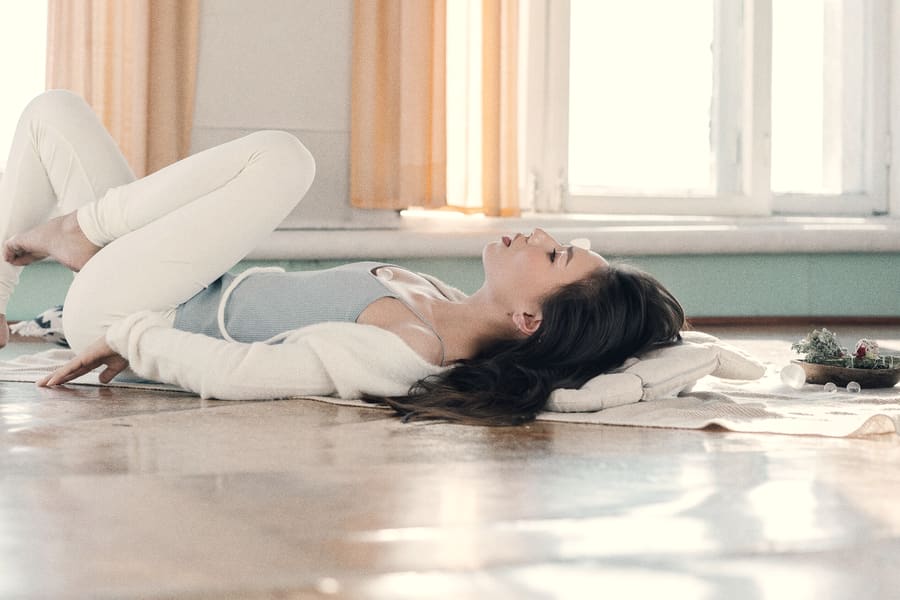
- Three minutes on your back, knees bent, a blanket under your head.
Four times a week beats seven times for two weeks and then nothing.
The last thing
The people who do best here are not the flexible ones or the young ones. They are the ones who come twice a week for a year without doing anything dramatic in any single class.
That is available to anybody, and it is much more available at 46 than at 26, because at 46 rather fewer people are trying to impress anyone.