Practice
What savasana is actually for
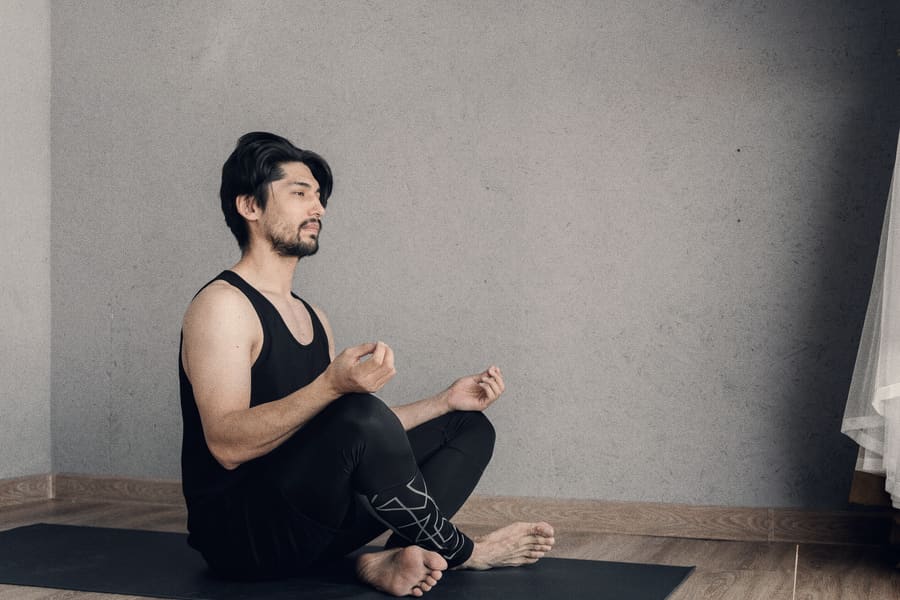
The last ten minutes are the part most often trimmed when a class runs long, and the part with the strongest claim to being the practice rather than the cool-down.

Every teacher has done it. The sequence overran, there are nine minutes left, and there is a choice between cutting two poses you had planned or cutting savasana to four minutes. The second option feels smaller. It is not.
At Halcyon the rule is explicit: if a class is running long, the sequence gets shorter and the ending does not. Teachers are told this in their first week. Here is the reasoning.
The mechanism, briefly
Something specific happens in the last ten minutes of a class, and it is not rest in the ordinary sense.
A practice — even a slow one — is a sustained sympathetic load. Heart rate up, respiration up, attention outward, muscles cycling through effort. Savasana is the interval in which the system is given permission to swing the other way, and that swing is not instantaneous. It takes several minutes for heart rate variability to shift, for respiration to lengthen without being told to, and for the muscles that have been quietly holding to actually let go.
Cut it to four minutes and you get the beginning of that process. The class was a stress you did not finish recovering from. Cut it to nothing and you have run an exercise class with incense.
The pose is not the practice. The pose is the argument. Savasana is where the body decides whether it was convincing.
Why it is the hardest pose in the room
Nobody says this on their first visit and almost everybody agrees by month three.
Every other shape gives you something to do. Savasana removes the task, and what surfaces is whatever the task was covering. For a lot of people that is the first unstructured ten minutes they have had in a week — no screen, no conversation, no decision — and the mind arrives with a list.
The traditional instruction is to observe the list rather than write it. That is genuinely difficult, and the difficulty is not a sign you are doing it wrong. Restlessness in savasana is information, not failure.
Making it work
A few practical things, in roughly the order they help.
- Get warm before you get still. Body temperature drops in stillness. Take a blanket, even in August, especially in August when the room has been ventilated.
- Prop the lower back. A bolster or rolled blanket under the knees flattens the lumbar curve slightly and stops the low back being the thing you are aware of for ten minutes.
- Let the exhale get longer without forcing it. Not a breathing exercise. Just stop cutting the out-breath short.
- Give it four minutes before you judge it. The first three or four are almost always the busiest. People who leave early leave in exactly the window before it starts working.
- Do not set an alarm. The teacher is watching the clock. That is the job.
On leaving early
People sometimes slip out during savasana, usually apologetically, usually because of a train. It is genuinely fine and no teacher here minds. The one request is to leave before it starts rather than during — the sound of someone rolling a mat is remarkably loud in a room of thirteen people going quiet.
If you know you have to go, take the mat nearest the door and go at the start of the ending. Nobody will look up. That is rather the point of the room.
The measure of a good ending
You can tell whether a savasana worked by what the room sounds like in the thirty seconds after the teacher speaks again. If people sit up and immediately start talking, it did not. If there is a long pause, some slow blinking, and the first conversation happens by the shoe rack rather than on the mat — it did.
We aim for the second one. It is the reason the last class of the evening is scheduled to finish fifteen minutes before the doors are locked.